What if we could see beyond what the eyes can see? Radiology and medical imaging make this possible, helping uncover hidden conditions, support accurate diagnosis and guide life-saving treatments. At City Medicals, we combine modern imaging technology with the expertise of our well-trained staff to deliver reliable results and exceptional patient care. Below are the different radiology and imaging techniques we offer and how each one plays a vital role in your health and well-being.
ECG (Electrocardiogram).
It is a diagnostic test commonly used in cardiology to examine the electrical activity of the heart. An ECG records the electrical signals that control the heartbeat. Small electrodes placed on the skin detect these signals and produce a tracing.
An ECG helps to;
- Detect abnormal heart rhythms.
- Identify signs that may suggest a heart attack.
- Asses electrical conduction problems.
- Detect and monitor certain heart conditions such as heart disease and the effects of some medications.
Why would I need to get one?
- Symptoms that may be coming from the heart like chest pain, heart racing and shortness of breath.
- If one is going to undergo major surgery, as a sort of preoperative testing.
- As an inquiry if there is family history of heart disease, an ECG can be used as a screening tool to make sure one does not have a heart problem as well.
A yearly ECG is a good baseline for everyone, particularly for patients that are at a high risk such as; high blood pressure, diabetes, high cholesterol or a family history.
MSK (Musculoskeletal Ultrasound) Scan.
It is a safe, non-invasive diagnostic imaging test that uses high-frequency sound waves to create real time pictures of muscles, tendons, ligaments, nerves, joints and soft tissues of the body.
An MSK helps to;
- Detect muscle tears.
- Examine tendons.
- Check ligaments.
- Investigate joint pain.
- Detect fluid and swelling.
- Examine soft tissue lumps.
- Guide treatment.
- Monitor healing.
Why would I need to get one?
- Persistent joint pain.
- Muscle or tendon injuries.
- Numbness or tingling in the hands or feet.
- Unexplained lumps or swelling.
- Limited mobility and stiffness.
Digital X-Rays.
It is a modern medical imaging technique that captures internal body structures using electronic sensors instead of traditional photographic film. It is commonly used for checking bone structures, chest conditions and dental health.
Digital X-rays can help to;
- Examine chest conditions.
- Identify spinal problems.
- Detect dental problems.
- Locate foreign objects.
- Detect bone infections.
- Diagnose joint problems.
- Detect bone fractures.
Why would I need to get one?
- Abdominal issues such as bowel obstructions and having swallowed a foreign object.
- Checking for kidney stones.
- Dental health.
- After an accident or fall.
- When you have chest problems such as; difficulty breathing, chest pain and persistent coughing.
- When you experience a swelling after an injury.
Doppler scan.
It is a non-invasive imaging test used to measure and evaluate the flow of blood through your blood vessels. This is commonly used in pregnancy, vascular health and cardiology.
A doppler scan helps to;
- Detect blood clots.
- Detect blocked and narrowed vessels.
- Assess blood flow during pregnancy.
- Examine vein function.
- Check heart condition.
- Monitor certain vascular conditions, before and after some treatments or procedures.
Why would I need to get one?
- Presence of blood clots to check for deep vein thrombosis. (DVT)
- Pregnancy precautions.
- When you have varicose veins. These are visibly large, twisted veins that usually appear on the legs and feet.
- Renal blood flow.
- Peripheral artery disease.(PAD)
- Carotid Artery Stenosis.
3D/4D Ultrasonography.
These are advanced medical imaging tec
hniques that use high frequency sound waves to create multi-dimensional visuals of the inside body.
3D/4D Ultrasonography can help to;
- Monitor pregnancy and fetal development (Obstetrics).
- Gynecology & Reproductive medicine.
- Oncology, Urology & interventional procedures.
Why would I get one?
- To measure the exact volume of fibroids or ovarian cysts before planning surgical removal.
- Locating IUDs (Intrauterine Device)
- Monitoring cancer therapies.
- Surgical and interventional planning.
- Selective prenatal bonding.
- Assessing fetal behavioral development.
Mammography.
A mammography is an essential tool for the early detection of breast cancer. Regular mammograms can help save lives by identifying breast cancer at its earliest and most treatable stage.
A mammogram can help to;
- Detect breast cancer early.
- Identify lumps.
- Investigate breast changes.
- Detect tiny calcium deposits.
- Guide further treatment.
Why would I get one?
- Presence of a breast lump.
- Changes in breast size or shape.
- Nipple inversion.
- Unusual nipple discharge.
- Skin dimpling.
- Persistent breast pain.
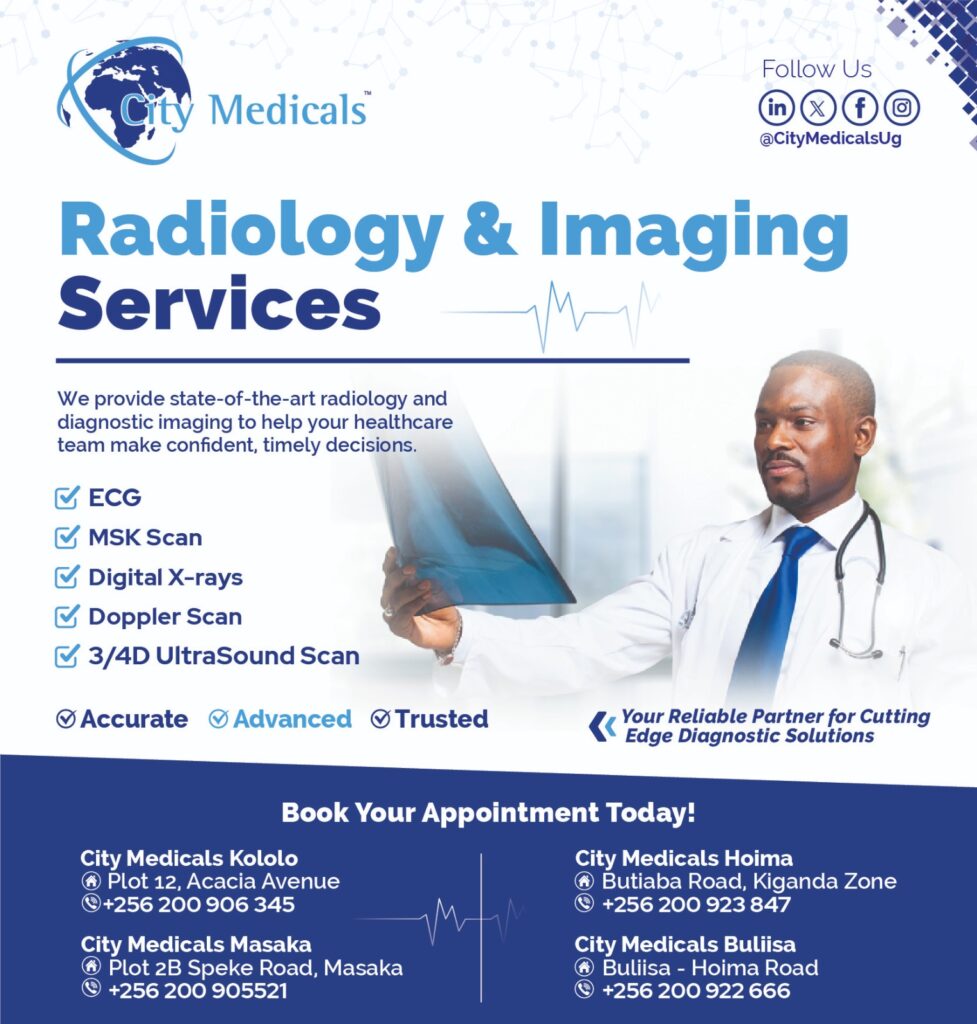
Radiology and medical imaging are vital in modern health care, helping doctors get a clearer understanding of what is happening inside the body. Your health deserves the best, and we are here to help you see it through. Visit a City Medicals branch in Kololo, Buliisa or Hoima. For appointments and inquiries, call us on 0200906345, WhatsApp 0709740261, or visit our website at www.citymedicals.org.
City Medicals – Seeing Beyond the surface, Caring beyond expectations.